Water Hardness Areas in London
London is famous for its landmarks, bustling streets, and unfortunately, its hard water. Most of the water flowing from taps across the city is hard or very hard, meaning it contains elevated levels of calcium and magnesium minerals.
Hard water can lead to limescale deposits, reduce the efficiency of appliances, and affect cleaning. In this guide, we cover the hardness levels in every London borough, explain the effects, and provide practical solutions for homes and businesses.
What Is Water Hardness?
Water hardness is caused by dissolved calcium (Ca²⁺) and magnesium (Mg²⁺) in the supply. The level depends on local geology, such as chalk and limestone aquifers, which release minerals into the water.
Hardness is expressed in mg/L of CaCO₃ (calcium carbonate). Here’s the UK classification:
| Hardness (mg/L CaCO₃) | Category |
|---|---|
| 0–100 | Soft |
| 101–150 | Slightly Hard |
| 151–200 | Moderately Hard |
| 201–300 | Hard |
| >300 | Very Hard |
Most London boroughs are hard or very hard, creating a widespread need for water softening solutions.
London Water Hardness by Borough
| London Borough | Average Hardness (ppm) | Category |
|---|---|---|
| Barnet | 327 | Very Hard |
| Enfield | 316 | Very Hard |
| Harrow | 305 | Very Hard |
| Barking & Dagenham | 301 | Very Hard |
| Kingston upon Thames | 296 | Very Hard |
| Westminster | 295 | Very Hard |
| Brent | 293 | Very Hard |
| Richmond upon Thames | 292 | Very Hard |
| Havering | 290 | Very Hard |
| Hounslow | 288 | Very Hard |
| Hillingdon | 286 | Very Hard |
| Greenwich | 284 | Very Hard |
| Redbridge | 283 | Very Hard |
| Ealing | 281 | Very Hard |
| Newham | 278 | Very Hard |
| Haringey | 276 | Very Hard |
| Waltham Forest | 276 | Very Hard |
| Lewisham | 275 | Very Hard |
| Hammersmith & Fulham | 274 | Very Hard |
| Kensington & Chelsea | 271 | Very Hard |
| Wandsworth | 271 | Very Hard |
| Croydon | 271 | Very Hard |
| Islington | 266 | Very Hard |
| Hackney | 266 | Very Hard |
| Merton | 261 | Very Hard |
| Bromley | 258 | Very Hard |
| Sutton | 253 | Very Hard |
| Tower Hamlets | 252 | Very Hard |
| Southwark | 251 | Very Hard |
| Camden | 246 | Hard to Very Hard |
| Lambeth | 236 | Hard |
| Bexley | 219 | Hard |
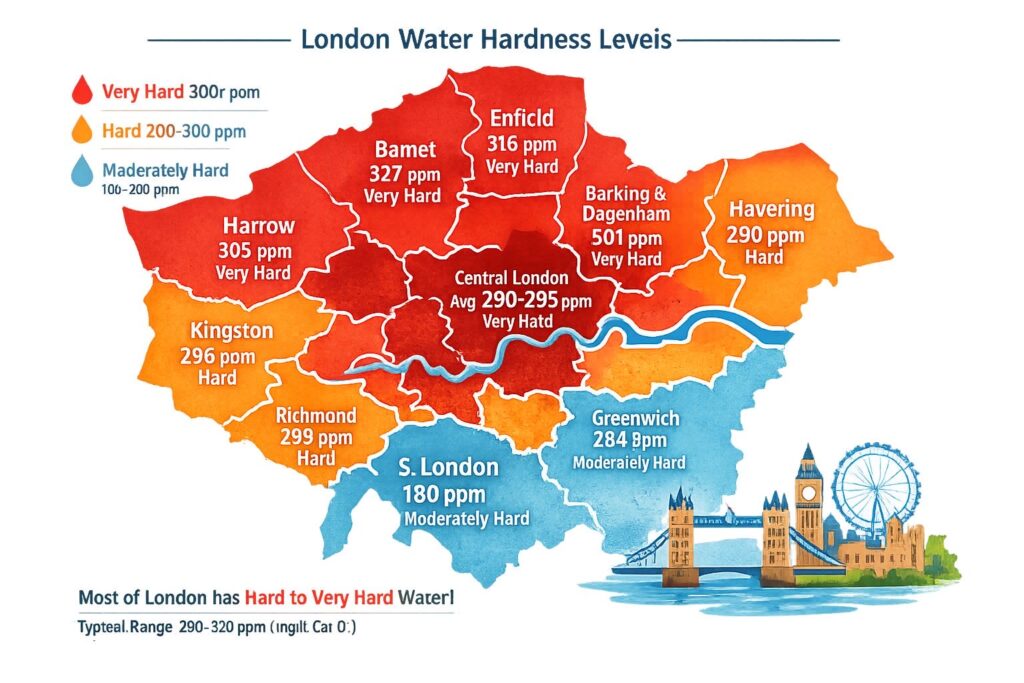
London Water Hardness Map
This illustrated map shows typical water hardness levels across Greater London, measured in parts per million (ppm) of calcium carbonate (CaCO₃). As highlighted, most of London falls within the hard to very hard water range, which is the main cause of limescale buildup in boilers, pipework, taps, showers, and household appliances.
Hard water is naturally occurring in London due to the surrounding chalk and limestone geology. While safe to drink, high mineral content can reduce appliance efficiency, increase energy costs, and shorten the lifespan of heating and hot-water systems.
London Water Filter specialises in filtration and scale-protection solutions designed specifically for London’s hard water conditions. This map is intended as a visual guide; exact water hardness can vary by postcode. For precise readings and tailored recommendations, contact our team.
Hard Water Hotspots in London (Postcode Level)
Some areas have extremely high water hardness, exceeding 350 ppm, creating a higher risk of limescale.
| Location / Postcode | Hardness (ppm) |
|---|---|
| Epping (CM16) | 370 |
| High Barnet (EN5) | 347 |
| Holloway Road (N7) | 338 |
| Cockfosters (EN4) | 337 |
| Edgware (HA8) | 335 |
| Arnos Grove (N11) | 333 |
| Stanmore (HA7) | 332 |
| Rickmansworth (WD3) | 332 |
| Tottenham Hale (N17) | 332 |
| Lancaster Gate (W2) | 330 |
Residents in these zones benefit most from water softeners or filtered taps.
Effects of Hard Water
Limescale Formation – Hard water deposits calcium and magnesium salts on heating elements, pipes, and appliances.
Reduced Appliance Efficiency – Heating efficiency drops and appliances may fail sooner.
Soap Ineffectiveness – Hard water reacts with soap, reducing lather and leaving residue on clothes, dishes, and surfaces.
Visible Residue – Tide marks on sinks, baths, toilets, and scum on hot drinks (e.g., tea) can appear.
Pipe Corrosion Risk – Extremely soft water (<100 mg/L) can be corrosive; very hard water can damage heating elements.
Softening Your Water
There are several ways to reduce hardness:
Ion-Exchange Softeners: Replace calcium and magnesium with sodium ions. Best installed before hot water tanks, not kitchen taps used for drinking.
Lime-Soda Softening: Adds lime and sodium carbonate to precipitate hardness compounds (used in municipal supply).
Filtered Jugs with Resin Beads: Reduce temporary hardness, improve taste, and reduce scum in beverages.
Magnetic or Electronic Scale Reducers: Alter crystal structure but do not remove hardness. Only partially prevent scaling.
Always use reputable suppliers and qualified plumbers for installation. Maintain the system regularly to prevent hygiene issues.
Should You Use a Water Softener?
Softening is optional, but highly recommended if you live in a hard or very hard water area:
Improves appliance efficiency
Extends lifespan of boilers, kettles, and washing machines
Makes soap and detergents more effective
Reduces tide marks and scale deposits
Safety note: Do not soften drinking water for infants or those on low-sodium diets.
FAQ
Q1: Is hard water safe to drink?
Yes, it is perfectly safe. Hard water contains beneficial calcium and magnesium.
Q2: Can hard water damage my pipes?
Long-term limescale can clog pipes and reduce appliance efficiency, but it does not corrode metal.
Q3: Can I soften water at home without a full system?
Yes, point-of-use filters, softening jugs, and filtered taps can help reduce temporary hardness.
Q4: How do I know my water hardness?
Check your borough-level average or contact your water supplier for postcode-specific readings.
Conclusion
London’s water is mostly hard or very hard, with the highest levels in north and west boroughs. Understanding water hardness helps you choose the right softening system, protecting your home, appliances, and plumbing.
Using this guide, residents can make informed decisions about softeners, filtered taps, and limescale prevention devices, ensuring efficient, long-lasting appliances and cleaner water at home.